
“The doctor said I have bone-on-bone arthritis. Does that mean I need surgery now?” It’s one of the most common, and most anxiety-inducing, questions older adults ask after a knee X-ray. The reassuring answer is that a severe diagnosis on imaging doesn’t automatically mean surgery is your only option, or even your next step. This guide walks through the real need for knee replacement surgery, when it genuinely applies, and what knee pain treatment options are worth trying first according to an orthopaedic in Delhi.
The Real Numbers: How Many People Actually Need Knee replacement surgery?
Knee osteoarthritis is genuinely common in older age, and its impact is real: research shows up to 80% of people with knee osteoarthritis are older than 55. They experience some degree of mobility limitation, and roughly a quarter struggle with basic daily activities. But here’s the reassuring part that often gets lost: the overwhelming majority of these cases are managed without surgery. Clinical guidelines from the American Academy of Orthopaedic Surgeons place conservative, non-surgical treatment as the clear first-line approach for knee osteoarthritis, with surgery reserved for a smaller subset of patients who don’t achieve adequate relief through other means.
Non-Surgical Treatment Methods for Knee Pain in Old age
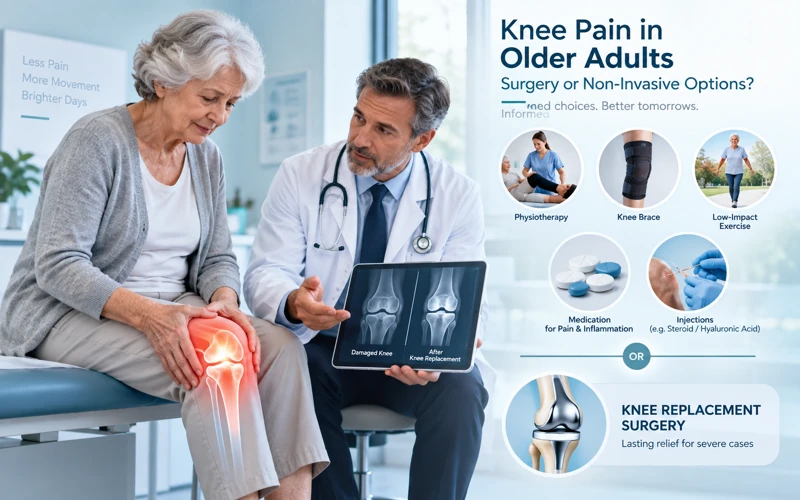
Rather than jumping straight to “surgery or nothing,” orthopaedic treatment for knee pain in old age typically follows a structured progression, each step tried and evaluated before moving to the next.
Step 1: Education, Weight Management, and Activity Modification
This is the foundation, not a formality. Every extra kilogram of body weight adds multiplied pressure on the knee joint with each step, so even modest, sustainable weight loss can meaningfully reduce pain and slow further joint damage. Simple activity adjustments, like reducing high-impact movements while staying active in lower-impact ways such as swimming or cycling, also matter significantly here.
Step 2: Structured Physical Therapy
Targeted exercise programs that strengthen the muscles supporting the knee, particularly the quadriceps, are considered core, first-line treatment by essentially every major clinical guideline. Physical therapy doesn’t just ease pain, it can genuinely improve joint stability and function, sometimes reducing the biomechanical stress that’s driving the pain in the first place.
Step 3: Medication
Topical or oral anti-inflammatory medications (NSAIDs) can provide meaningful symptomatic relief for many patients with mild to moderate pain. It’s worth understanding what these medications can and can’t do: they manage pain, they don’t repair or slow cartilage damage, so they work best as one part of a broader plan rather than a standalone solution.
Step 4: Injectable Treatments
When medication and physical therapy alone aren’t providing sufficient relief, several injectable options can offer meaningful additional support:
- Corticosteroid injections reduce inflammation directly in the joint, offering relief that’s generally effective but relatively short-lived
- Viscosupplementation (hyaluronic acid injections) replace the joint’s natural lubricating fluid, which becomes less effective in osteoarthritis, helping cushion the joint and ease pain, with relief that can last several months for many patients
- Platelet-rich plasma (PRP) injections use concentrated growth factors from your own blood to target inflammation, an increasingly used option, though results vary between patients and long-term comparative data is still developing
Step 5: Newer Minimally Invasive Options
For patients who’ve tried standard conservative measures without adequate relief, but who aren’t ready for or candidates for surgery, newer image-guided procedures like genicular nerve radiofrequency ablation and genicular artery embolisation are increasingly being used to target pain signals or abnormal inflammatory blood flow around the knee directly, without an incision into the joint itself.
So, When Does Knee Replacement Surgery Actually Become Necessary?
Surgery becomes the recommended path when a meaningful combination of the following applies:
- Pain is severe and persistent despite properly trying conservative treatment for a reasonable period
- The pain significantly limits daily activities, walking, climbing stairs, sleeping, or basic independence
- X-rays confirm advanced joint damage consistent with the severity of symptoms
- Quality of life has been substantially and consistently affected, not just occasionally
Importantly, the decision isn’t based on X-ray severity alone. Some people with “bone-on-bone” imaging findings have relatively manageable symptoms and continue with conservative care for years, while others with moderate imaging findings have pain severe enough to justify surgery sooner. The clinical picture, not the scan alone, drives the decision.
Knee Pain in Old Age Treatment Without Surgery: Is It Really Effective Long-Term?
For many patients, yes, genuinely. Conservative treatment isn’t simply a stalling tactic before an inevitable surgery, for a substantial proportion of patients, particularly those who engage consistently with weight management and physical therapy, non-surgical treatment provides durable, meaningful relief for years. That said, it’s honest to acknowledge that for more advanced, severe cases, non-surgical treatment may manage symptoms rather than resolve them entirely, which is exactly why ongoing follow-up with an orthopaedic specialist matters, to reassess whether your current approach is still serving you well, or whether it’s time to revisit the conversation about surgery.
Knee Replacement Surgery Cost in Delhi
Knee replacement surgery cost in Delhi typically ranges from approximately ₹1.5 lakh to ₹6.5 lakh per knee, depending on the hospital, the specific implant used, and whether it’s a total or partial knee replacement. Non-surgical treatments, by comparison, are generally far less expensive per intervention, though they may involve ongoing costs over time, such as repeat injections every several months, which is worth factoring into your overall decision alongside the clinical picture.
When to See an Orthopaedic Specialist in Dwarka
Book a consultation with an orthopaedic in Dwarka if your knee pain is persistent, worsening, or increasingly limiting your daily activities, particularly if you haven’t yet had a structured conservative treatment plan in place. It’s also worth a visit if you’re currently managing knee pain without a clear plan and want a proper orthopaedic evaluation to understand your actual options, rather than assuming surgery is your only path forward.
Knee replacement surgery is a genuinely effective option when it’s truly needed, but it isn’t the only path, or even the first step, for most people dealing with knee pain in old age. A structured, well-managed non-surgical approach provides real, lasting relief for many patients, while surgery remains available and often highly successful for those whose symptoms and daily function genuinely warrant it. If you’re navigating knee pain and unsure which path is right for you, The Bone Clinic in Dwarka offers experienced orthopaedic evaluation to help you understand your actual options.