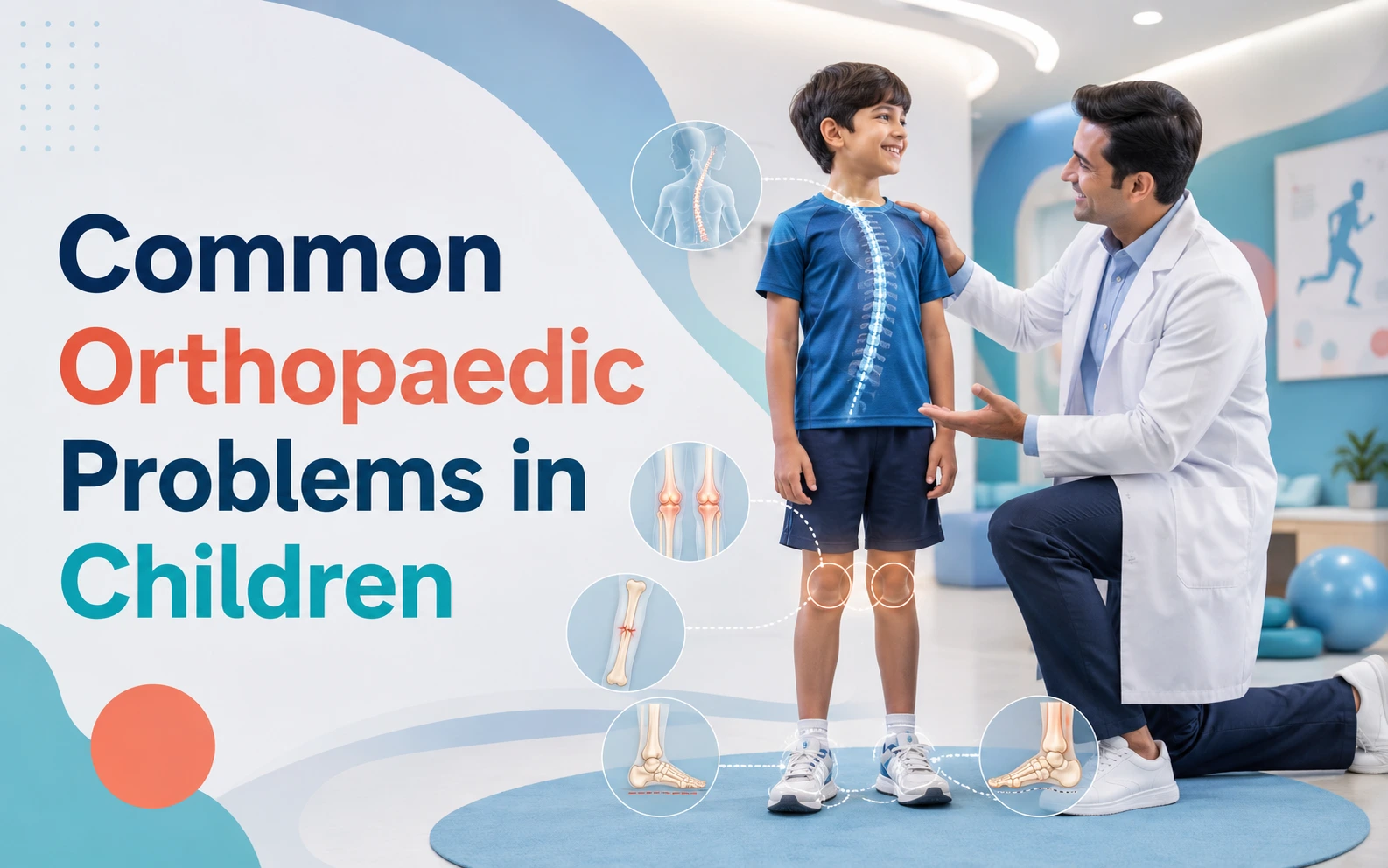
“Is this normal, or should we get it checked?” It’s a question most parents ask at some point as their child grows, whether it’s a toddler’s turned-in feet, a school-age child’s complaint of leg pain at bedtime, or a teenager’s changing posture. The truth is that a child’s musculoskeletal system, meaning their bones, joints, and muscles, changes constantly as they grow, and what counts as “normal” shifts with every developmental stage. Pediatrics orthopedics problems look different at every age, so this guide walks through the orthopedic problems in children most likely to appear at each stage, so you have a clearer sense of what to expect and when do you need a pediatric orthopaedics specialist in Delhi.
Why Age Matters So Much in Pediatric Orthopedics
A child’s skeleton isn’t a smaller version of an adult’s. Growth plates, the areas of developing cartilage near the ends of long bones, remain active until a child finishes growing, and much of what looks like an “abnormality” in a toddler is often simply a normal stage of skeletal development that will self-correct with time. This is precisely why pediatric evaluationby pediatric orthopedic specialist in Delhi looks so different from adult orthopedic care, and why age-appropriate context matters enormously when deciding whether something needs attention.
Infancy (Birth to 1 Year): What to Watch For
The newborn period is when several congenital, meaning present-from-birth, orthopedic conditions are typically identified.
- Developmental dysplasia of the hip (DDH) is checked for during routine newborn examinations. It occurs when the hip joint hasn’t formed properly, and catching it early, usually through a simple physical exam and sometimes ultrasound, allows for straightforward, non-surgical treatment with a harness in most cases.
- Clubfoot, where one or both feet turn inward and downward at birth, is another condition identified in early infancy, sometimes even before birth via prenatal ultrasound. It doesn’t cause pain for the baby, but early treatment, typically gentle, non-surgical casting, produces the best long-term walking outcomes.
- Metatarsus adductus, a milder inward curve of the front of the foot, is common in newborns and usually resolves on its own within the first year without any specific treatment.
Toddler Years (1 to 3 Years): The Walking and Alignment Stage
Once toddlers start walking, parents often notice leg and foot alignment patterns that can look concerning but are frequently just part of normal development.
- Bow legs are genuinely typical at this age, most toddlers have some degree of outward curving in their legs as they begin walking, and it usually straightens naturally over the following couple of years.
- In-toeing, where a child’s feet or knees point inward while walking, is also common and generally traced back to how the legs were positioned in the womb. The overwhelming majority of cases correct themselves without treatment as the child continues to grow.
- Toe walking is common in toddlers learning to walk and is often simply a habit that fades with time. Persistent toe walking beyond early childhood, however, particularly if it’s one-sided or accompanied by tight calf muscles, is worth having evaluated.
Preschool and Early School Age (4 to 8 Years): The Straightening-Out Phase
As children move through this stage, many of the alignment patterns seen in toddlers begin to reverse or settle.
- Knock knees frequently appear during this window, as legs that were bowed in toddlerhood swing the other way before eventually straightening by around age seven or eight in most children.
- Flat feet remain common through this age range as well; the foot’s arch typically continues developing through middle childhood, and true treatment is rarely needed unless flat feet are causing pain or clearly affecting how a child walks or runs.
- Perthes disease, a temporary disruption in blood supply to the hip’s growth centre, most often appears in this age group, typically between four and eight years old, and usually presents as a limp or hip and knee discomfort. While the name sounds alarming, most cases are managed successfully with monitoring, activity guidance, and physical therapy.
School Age to Preteen (9 to 12 Years): The Activity and Overuse Stage
As children become more physically active in structured sports, overuse injuries start becoming more common than developmental variations.
- Osgood-Schlatter disease, pain and mild swelling just below the kneecap where the patellar tendon attaches, is a frequent complaint in active, sporty children in this age range, particularly during growth spurts, and generally improves with activity modification and stretching rather than surgery.
- Growing pains, aching typically felt in the legs during evenings or at night, also commonly appear during this stage. They don’t cause limping or daytime symptoms, and they resolve without specific treatment, though persistent or one-sided pain should always be properly evaluated rather than assumed.
Adolescence (13 Years and Up): The Growth Spurt Stage
The rapid growth of adolescence brings its own distinct set of orthopaedic problems in children.
- Scoliosis, a sideways curve of the spine, most commonly develops or becomes noticeable during this stage’s growth spurt. It’s rarely painful early on, which is exactly why routine screening matters, since mild curves are easy to miss without a specific check. Management ranges from simple monitoring for small curves to bracing or, less commonly, surgery for larger ones.
- Sever’s disease, heel pain related to the growth plate at the back of the heel, and other overuse injuries tend to peak during adolescent growth spurts, when bone growth can briefly outpace the flexibility of surrounding muscles and tendons.
- Slipped capital femoral epiphysis, a condition where the growth plate at the top of the thigh bone shifts, though less common, typically appears in this age group and needs prompt evaluation, since it presents with hip, groin, or knee pain and a change in gait that shouldn’t be dismissed as a simple sports strain.
Children’s bones and joints go through a genuinely predictable series of changes as they grow, and understanding what’s typical for each stage helps take some of the guesswork, and worry, out of parenting. That said, trusting your own observations matters too: persistent, one-sided, or worsening symptoms are always worth a professional opinion rather than assumption. If you have questions about your child’s walking pattern, posture, or an ongoing ache that doesn’t fit the usual pattern for their age, The Bone Clinic in Dwarka is a trusted pediatric orthopedic hospital in Delhi. Contact the doctors to conduct evaluation and understand what’s actually going on.