

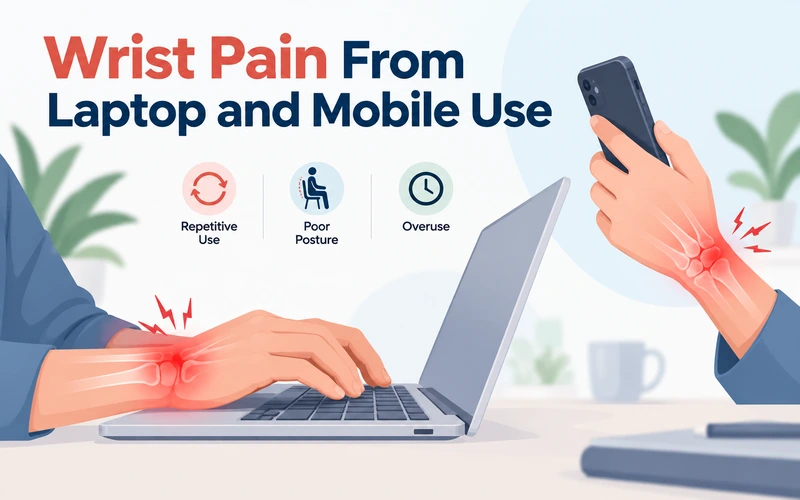
Your wrist wasn’t designed to hold the same bent position for eight hours a day, scrolling, typing, and gripping a phone in the exact same few positions over and over. Wrist pain from laptop and mobile use has become common enough that orthopaedic clinics see it across every age group now, not just older adults with wear-and-tear arthritis. Here’s what’s actually causing it, and what genuinely helps according to a bone specialist in Delhi.
Wrist pain from device use is most commonly caused by De Quervain’s tenosynovitis (inflammation of the thumb tendons from repetitive texting and scrolling) or carpal tunnel syndrome (nerve compression from prolonged wrist bending). Research shows heavy smartphone users, more than 8 hours a day, face higher odds of these conditions, and screen size and typing posture both play a measurable role.
The Real Reasons for Wrist Pain from Device Use
De Quervain’s Tenosynovitis
This condition involves inflammation and thickening of the tendon sheath at the base of the thumb, historically nicknamed “washerwoman’s sprain,” now increasingly called “texting thumb” or “SMS thumb.” Research has linked heavier smartphone use directly to this condition: one study found users on their phones more than 8 hours daily had roughly 4.5 times higher odds of developing it compared to lighter users, and holding the phone with both thumbs typing, rather than one hand cradling and one typing, was identified as a specific contributing gesture. Larger phone screens have also been associated with higher risk, likely because they demand a greater thumb reach and more sustained tendon strain per interaction.
Carpal Tunnel Syndrome
This involves compression of the median nerve as it passes through the wrist, causing numbness, tingling, or weakness typically in the thumb, index, and middle fingers. Extended wrist positioning during typing, particularly wrist extension beyond roughly 20 degrees, has been identified as a specific predisposing posture. It’s worth being precise here, though: research findings on computer use and carpal tunnel syndrome specifically are more mixed than commonly assumed, some studies find minimal correlation with typing duration alone, which suggests posture and total repetitive load matter more than simply “how many hours you type.”
Tendinitis and General Overuse Strain
Beyond these two named conditions, general tendinitis from repetitive gripping, scrolling, and thumb movement can cause aching, stiffness, and reduced grip strength without a specific diagnosis attached, particularly in people who combine heavy phone use with manual work or gym training that also loads the wrist and forearm.
How Doctors Actually Diagnose the Cause
For suspected De Quervain’s tenosynovitis, the Finkelstein test is the standard bedside check: the thumb is folded into the palm, the fist is made around it, and the wrist is bent toward the little finger side. Pain reproduced at the thumb-side base of the wrist during this manoeuvre is a strong positive sign.
For suspected carpal tunnel syndrome, doctors commonly use Phalen’s test, holding the wrists in full flexion for up to 60 seconds to see if it reproduces numbness or tingling, alongside Tinel’s sign, gently tapping over the nerve at the wrist crease. Phalen’s test tends to be the more reliable of the two on its own, research places its accuracy at roughly 68% sensitivity and 73% specificity, while Tinel’s sign runs lower on sensitivity, meaning doctors often combine both findings with your symptom history rather than relying on either test in isolation.
What Actually Helps: Evidence-Based Prevention
- Keep your wrist in a neutral position while typing, not bent upward past roughly 20 degrees, since this specific angle has been directly linked to increased strain during prolonged use
- Avoid the bilateral-thumbs typing grip for extended texting sessions, alternating hands or using voice-to-text periodically reduces the repetitive load research has tied to De Quervain’s specifically
- Take a genuine break every 30 to 45 minutes, even 60 seconds of stretching the wrist and thumb interrupts the sustained tendon loading that builds up over hours
- Support your forearm on the desk or armrest while using a laptop or mouse, rather than letting the wrist bear the weight of the hand unsupported
- Consider a larger phone held with a more relaxed grip, or a case that reduces the need to stretch your thumb as far to reach the screen
Setting Up Your Laptop to Actually Protect Your Wrists
A laptop’s built-in keyboard and trackpad force your wrists into a compromise position by design, the screen and keyboard are fixed together, so raising the screen to eye level (a common ergonomic tip) usually pushes the keyboard too high for a neutral wrist.
If you use a laptop for more than an hour or two a day, an external keyboard and mouse, with the laptop itself raised on a stand for screen height, lets your wrists sit flat and neutral while your eyes stay level with the screen, addressing both problems rather than trading one for the other.
A wrist rest can help maintain neutral positioning during pauses in typing, but resting your wrist on it while actively typing can itself increase pressure on the carpal tunnel, so it’s meant for breaks, not continuous contact.
Best Treatment for Wrist Pain: What to Expect
For mild, early symptoms, rest from the aggravating activity, a wrist splint that keeps the joint neutral, and over-the-counter anti-inflammatory medication resolve the majority of cases within a few weeks.
For De Quervain’s tenosynovitis specifically, a thumb spica splint, immobilising the thumb and wrist together, is typically more effective than a standard wrist splint alone. If symptoms persist beyond several weeks of proper rest and splinting, a corticosteroid injection into the tendon sheath or carpal tunnel is a common and effective next step before surgery is ever considered.
Surgical release is reserved for carpal tunnel cases with persistent nerve compression confirmed on nerve conduction studies, or De Quervain’s that hasn’t responded to conservative treatment and injections.
When Wrist Pain Needs an Orthopaedic Specialist, Not Just Rest
Book a consultation with an orthopaedic specialist in Dwarka if pain persists beyond two to three weeks despite rest and splinting, if you notice numbness, tingling, or weakness affecting your grip, or if pain is affecting your ability to work or sleep. Sudden severe pain following an injury, rather than a gradual onset from device use, should be evaluated promptly rather than assumed to be simple overuse.
Wrist pain from laptop and mobile use isn’t a single condition; it’s usually one of a few distinct, well-understood problems, each with a specific test and a specific treatment path. Simple posture and habit changes prevent a significant share of these cases entirely, but pain that persists beyond a couple of weeks deserves a proper diagnosis rather than continued guessing. The Bone Clinic in Dwarka offers thorough orthopaedic assessment to identify exactly what’s causing your wrist pain and the most effective way to treat it.
The Bone Clinic in Dwarka offers dedicated assessment for wrist and hand conditions alongside its broader orthopaedic practice in joint problems, sports injuries, and general orthopaedics. With an on-site physiotherapy and rehabilitation centre, X-ray facilities, and a proper clinical work-up, The Bone Clinic offers genuine diagnostic clarity rather than a generic “rest and see” response. We also coordinate further imaging or surgical care where needed through our hospital tie-ups. Learn more or book a consultation at theboneclinic.net.